


The Midlife Brain Reset: Finding Your Rhythm When Life Goes Offbeat

You’ve been doing the things. Sleeping better, hydrating, moving, maybe even habit stacking your way toward sharper focus and calmer mornings.
Then… life happens. I get it. Someone gets sick. Work gets chaotic. The dog eats something questionable (as they do). Suddenly, your brain feels foggy, your motivation flatlines, and your once-steady rhythm is more of a chaotic drum solo.
Here’s the truth: the brain loves rhythm — but it’s also forgiving when life gets offbeat. Let’s talk about how your daily rhythms support mood, memory, and motivation — and how to reboot when life (as it does) turns into a game of whack-a-mole.
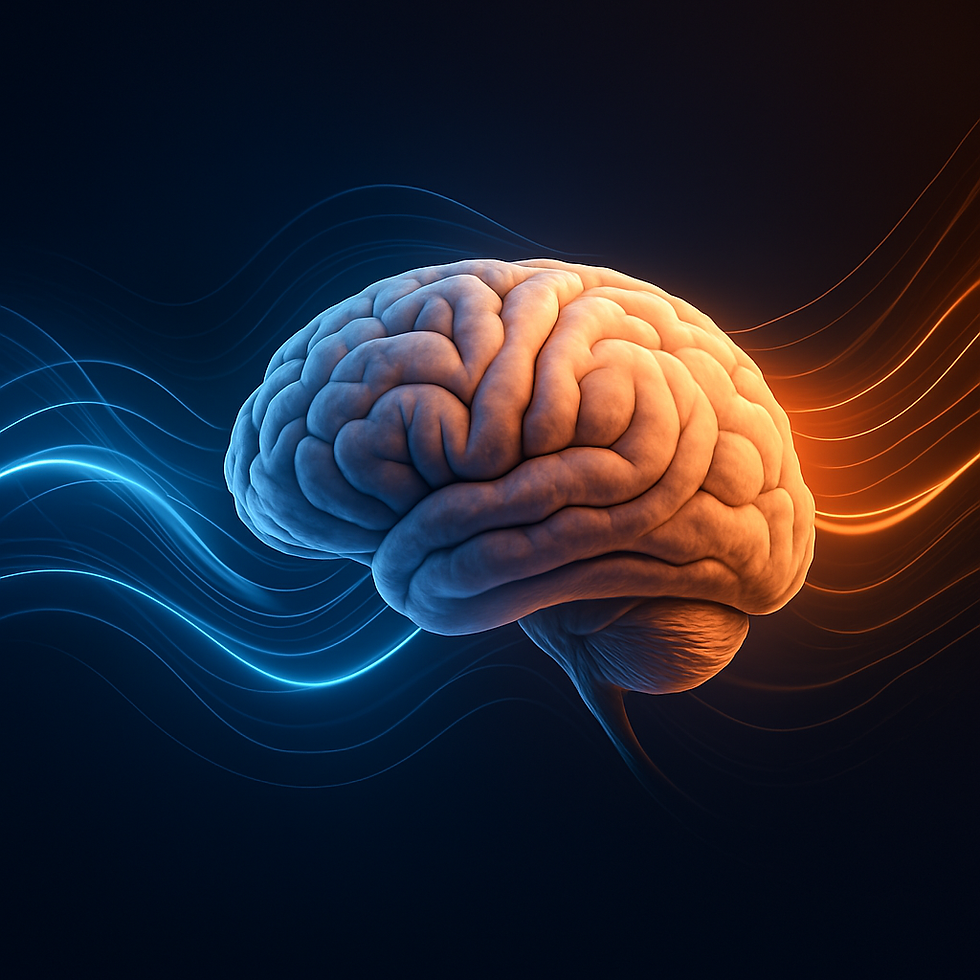
🧠 The Brain Loves Rhythm
Your brain is a pattern-seeking machine. It thrives on rhythm and routine because predictability feels safe. When your days have some structure, your nervous system can finally exhale — like, 'Ahh… we’re good here.' You see, routine helps your prefrontal cortex (the executive in charge of decision-making and focus) stay in the driver’s seat while calming the limbic system (the stress responder).
But when life starts to feel more like a game of whack-a-mole — one thing popping up right after another — that sense of safety goes out the window, and your brain scrambles to keep up. Cortisol surges, clarity drops, and suddenly even small tasks feel like mountains that need moving. It’s not that you’ve lost discipline — it’s that your brain’s internal conductor is trying to find the beat again.
🌦️ Mood: The Messenger
Low motivation, irritability, or that 'blah' feeling? They’re not personal failures — they’re messages from your brain.
Neurotransmitters like serotonin, dopamine, and GABA don’t just appear out of thin air; they need encouragement from the nutrients you eat, the sleep you get, and the stress you manage. When one of those inputs goes missing, your mood dashboard starts blinking yellow.
Routines help keep those chemical messengers in tune:
Sleep supports serotonin balance and emotional regulation (among other things).
Movement triggers dopamine and endorphins — instant mood lifters.
Connection releases oxytocin, your built-in antidote to feelings of isolation and anxiety.
So when your mood dips? It’s not a character flaw. It’s feedback—your brain waving a little flag that something needs attention.
🧩 Memory: The Repetition Effect
Neuroscientists call it long-term potentiation, but you can just think of it as 'neurons that fire together, wire together.'
Every time you repeat a routine — like journaling before bed or walking after lunch — your brain strengthens that neural pathway. Over time, that circuit gets faster, smoother, and more automatic. That’s why habits are like well-worn hiking trails: the more often you walk them, the easier they are to follow.
And if you miss a few days? You don’t erase progress. You just let a little grass grow back on the path. One walk — one return to routine — and the trail reappears.
⚡ Motivation: The Momentum Builder
Motivation isn’t a personality trait; it’s a chemical loop.
Every time you complete a small task, your brain releases dopamine, a little hit of 'Hey, that felt good — do it again.' That’s why small wins matter so much.
The formula is simple: Cue → Action → Reward → Repeat.
When life gets messy, we often skip straight to guilt instead of reward. But guilt short-circuits motivation.
The fix? Shrink the goal:
Didn’t work out today? Take a five-minute walk.
Didn’t meditate? Close your eyes and belly breathe for 60 seconds.
Didn’t meal prep? Grab some leftovers from the fridge and move on.
Each small act tells your brain, 'We’re still doing this.' And that’s enough to restart the dopamine loop. Even better if you remember to celebrate those small actions, as we mentioned in our last article (https://www.nourish2flourishwellness.com/post/small-habits-big-brain-gains-the-midlife-guide-to-sustainable-change).
🔄 The Reset Ritual
Here’s the thing: consistency isn’t about never leaving the trail — it’s about how quickly you find your way back.
When you hit that 'off rhythm' moment, try this quick mental reset:
R.E.S.E.T.
Reflect: What’s actually throwing me off? (Sleep? Stress? Overwhelm?)
Exhale: Literally. A long exhale (longer than your inhale) lowers cortisol in seconds.
Simplify: Choose one small action — the easier, the better.
Engage: Start. Even one minute of momentum can build into more.
Try again: Perfection isn’t the bar — participation is.
Your brain doesn’t need guilt or punishment. It needs patience, grace, and a clear next step.
💪 The Bottom Line
Protecting your brain isn’t about doing everything right. It’s about noticing when things start to slide and gently steering yourself back — no guilt trip required.
Every reset, every 'let’s try that again,' literally strengthens the neural pathways that help you adapt and grow stronger. That’s the definition of neuroplasticity — your brain learning that you can recover, rebuild, and keep moving forward.
So when life inevitably throws chaos your way, remember: You don’t have to be perfect — you just have to keep showing up.
✨ Your brain’s paying attention. Teach it that it’s safe, supported, and fully capable of finding its rhythm again (even after a few rounds of whack-a-mole).
👉 Next week: We’ll explore how to future-proof your focus — because midlife brains aren’t slowing down; they’re just getting smarter about what matters most.


Comments